

Signs of Dried Out Cigar Tobacco: A Guide
Table of Contents
- What Dried Out Cigar Tobacco Looks and Feels Like
- How to Tell If a Cigar Is Dry: A Diagnostic Checklist
- How Dryness Affects Lighting, Burn, and Smoke
- Can You Smoke a Dried-Out Cigar? When to Avoid It
- How to Rehydrate a Dry Cigar Safely
- Ideal Humidity for Cigar Storage and Prevention
- Frequently Asked Questions
Last Updated: October 21, 2026
What Dried Out Cigar Tobacco Looks and Feels Like
A dried-out cigar shows clear physical signs that separate it from normal aging or proper storage. Look for changes across the wrapper, feel, and weight.
The wrapper tells the story first; the binder and filler respond in ways you can feel and sometimes hear. Catching these changes early saves the cigar.
Visual Signs: Wrapper Damage and Color Changes
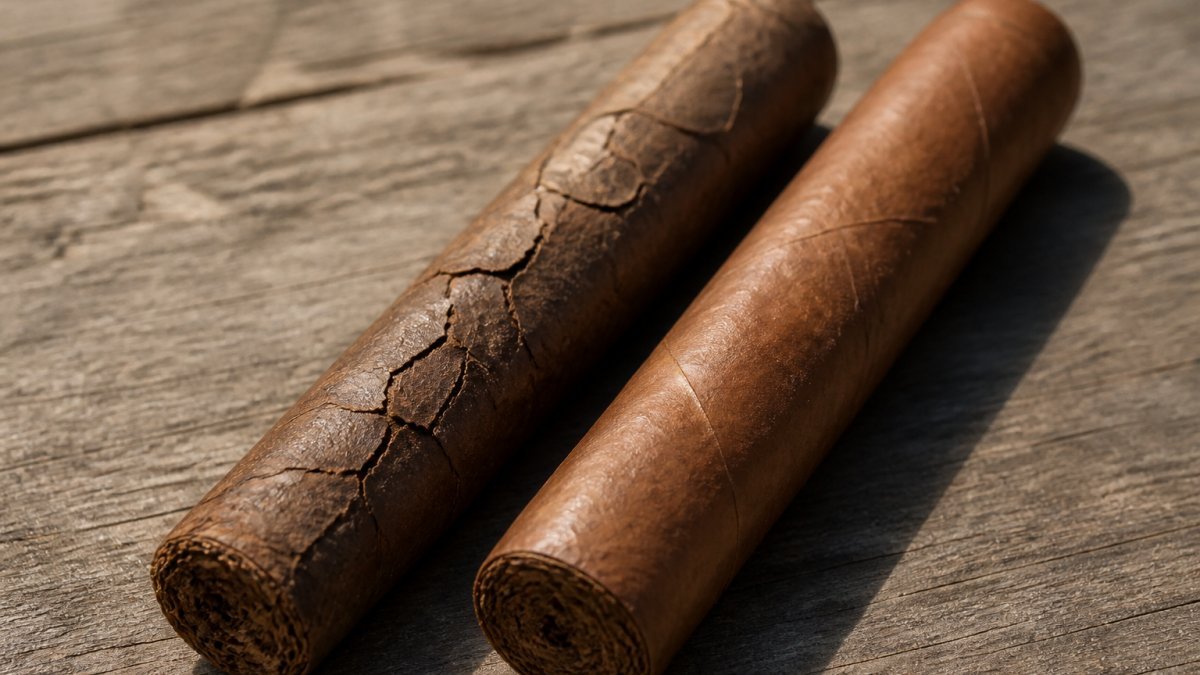
The wrapper is your first diagnostic tool. When a cigar dries out, the wrapper loses its elasticity and begins to show stress. Look for these specific changes:
- Visible cracks or splits running lengthwise along the wrapper
- Color fading from a rich, even tone to a dull, lighter shade
- Veins becoming more prominent as the wrapper shrinks
A fresh wrapper feels smooth and supple; a dried one feels papery and brittle. Run a finger along it, if it feels like tissue paper, dryness is the problem.
Under-humidified cigars also develop a waxy or flaky surface as tobacco oils rise while moisture leaves. It looks like dust but doesn’t brush away cleanly.
Texture and Feel: Brittleness and Weight Loss
A properly humidified cigar gives slightly when squeezed; a dried-out cigar feels hard and unyielding, like a wooden dowel.
Press along its length: you should feel gentle resistance, not a snap.
Weight is another quick test. Compared to a fresh cigar from the same brand, dried-out cigars are noticeably lighter, they’ve lost internal moisture.
Listen as well: gently bend the cigar. A dry one produces a faint crackling sound; a properly humidified cigar bends silently.
How to Tell If a Cigar Is Dry: A Diagnostic Checklist
Not every cigar problem is dryness, cracks can come from construction defects, discoloration from mold or beetle damage. Use this checklist to confirm.
Signs pointing to dryness:
- Wrapper feels papery and brittle
- Cigar is noticeably light for its size
- Wrapper has lengthwise cracks but no soft spots
Signs pointing to other problems:
- Soft, spongy feel (over-humidification)
- Visible mold or white spots (mold damage)
- Holes or tunnels in the wrapper (beetle damage)
Under-Humidified vs. Over-Humidified Cigars
An under-humidified cigar is hard, light, and brittle: the wrapper cracks, the smoke is thin, the flavor turns harsh and bitter, and the burn races and tunnels.
An over-humidified cigar is soft, spongy, and heavy, with a damp wrapper, thick wet smoke, a slow burn that may go out, and muted flavor.
A hygrometer removes guesswork. Seal the cigar with one for 24 hours: above 75% relative humidity means over-humidified, below 60% means under-humidified. The ideal range is 65-72%.
How Dryness Affects Lighting, Burn, and Smoke
Dried-out cigars light easily but burn badly because the moisture-depleted tobacco ignites faster. The experience deteriorates from the first light.
Uneven Burn and Tunneling
A dried cigar often tunnels: one side burns faster, creating a hollow channel down the center while the wrapper stays intact.
Dry filler tobacco has uneven moisture distribution, so some parts ignite before others and the burn line can’t stay even.
You may also see canoeing, where one edge burns faster and the ash curls up.
The burn rate accelerates, a 45-minute cigar may finish in 30, and the excess heat damages flavor compounds.
Thin Smoke and Harsh, Bitter Flavor
Smoke volume drops noticeably: thin and wispy instead of thick and creamy, because moisture produces better smoke.
The flavor turns harsh and acrid. Dried tobacco loses its subtle notes, leaving bitterness and a peppery bite that overshadows any complexity.
Many smokers describe dried cigars as tasting like burnt hay or straw, tobacco that has lost its oils and aromatic compounds to evaporation.
Can You Smoke a Dried-Out Cigar? When to Avoid It
You can smoke a mildly dried cigar if you accept a diminished experience, the question is whether it’s worth your time.
A severely dried cigar is not worth smoking. The flavor is ruined. The burn is unpredictable. You’ll spend 30 minutes frustrated instead of relaxed.
Avoid smoking a dried cigar if:
- The wrapper has deep cracks or splits
- The cigar crumbles when you handle it
- The flavor is already acrid or bitter on the cold draw
Smoke a mildly dried cigar only if:
- The wrapper is intact with minor surface cracks
- The cigar still has some flexibility
- You have time to rehydrate it first
The cold draw test helps: before lighting, draw on the unlit cigar. An extremely tight draw with almost no flavor means it’s too dry to smoke well; a normal draw with flavor means rehydration may save it.
How to Rehydrate a Dry Cigar Safely
Rehydration works, but it is a controlled process, not a quick fix. Raise the cigar’s internal moisture slowly enough that wrapper, binder, and filler expand together. Move too fast and the brittle wrapper splits while the filler swells, or you push into mold territory. The protocol below uses measurable checkpoints so you can tell whether the cigar is recovering.
Why Slow Beats Fast
Tobacco is hygroscopic: it absorbs and releases moisture in response to the air (ncbi.nlm.nih.gov). A dried cigar has shrunk across all three components, and each layer reabsorbs water at a different rate, the thin wrapper rehydrates quickly while the dense filler lags.
The second risk is mold, which needs sustained high humidity, poor air circulation, and organic material, all provided by a sealed container of tobacco. Keeping humidity in the mid-60s to low-70s and monitoring with a hygrometer is the guardrail.
The Gradual Rehydration Protocol
Use an airtight container (a food-grade plastic container with a gasket works well), a calibrated digital hygrometer, and humidity packs rated for the target range. Skip sponge-based humidifiers, they release moisture too aggressively.
- Baseline reading (Day 0). Place the hygrometer in the empty container for 1-2 hours to confirm it reads ambient room humidity accurately. If it is off by more than a few points, calibrate it first.
- Start low (Days 1-5). Place the dried cigars and a humidity pack rated around 62-65% relative humidity in the sealed container. Keep it at stable room temperature, out of direct sun and away from heat sources. Do not open it for the first 5 days.
- First checkpoint (Day 5). Open briefly, feel one cigar through the wrapper, and reseal. You want the wrapper less papery, not yet supple. If the hygrometer reads below 60%, the pack is undersized or the seal is leaking; add a second pack of the same rating.
- Step up (Days 6-12). Swap to a pack rated around 65-69% relative humidity. Reseal and leave undisturbed for another 5-7 days.
- Second checkpoint (Days 12-14). Remove one cigar and perform the gentle squeeze test along its length. Mildly dried cigars should now show slight give. If the wrapper still crackles, return it and continue at the same rating for another 5 days.
- Finish (Days 14-21). For most mildly dried cigars, 14-21 days at 65-69% brings the wrapper back to a supple feel and restores weight. Move the recovered cigars to your main humidor at your normal storage humidity and let them rest at least a week before smoking so the moisture equalizes through the filler.
Do not rehydrate for more than about 30 days. If a cigar has not recovered feel and weight by then, it is likely structurally compromised and further time raises mold risk without improving the smoke.
Measurable Checkpoints and Stop Conditions
Rely on readings and physical tests rather than a calendar alone. Three signals matter:
- Hygrometer reading. Keep the container between roughly 62% and 69% relative humidity during the ramp. A sustained reading above 72% means you are pushing too hard, remove the pack, air the container for an hour, and resume at a lower rating.
- Wrapper feel. Papery and crackling means keep going; supple with gentle give means the wrapper has recovered. A wrapper that feels damp or sticky means you have overshot.
- Weight and squeeze. A cigar that still feels noticeably light for its size after two weeks is not fully rehydrated. A cigar that feels spongy is over-humidified and needs to rest in a drier environment.
Stop and discard rather than rehydrate if you see fuzzy white or blue-green growth, a persistent ammonia smell that doesn’t fade after airing, pinholes in the wrapper, or a wrapper that crumbles at a touch. These are mold, pest, or severe structural problems rehydration won’t fix and can spread to your collection.
Component-by-Component Expectations
Dryness and recovery differ by tobacco form:
- Wrapper. Fastest to show damage (cracks, fading, prominent veins) and fastest to recover feel, but also the most prone to splitting if rehydrated too quickly.
- Binder and filler. Slower to dry out visibly but slower to recover; this is why a cigar can feel right on the outside while still smoking hot and thin. The post-recovery rest period in the humidor matters most for these layers.
- Loose cigar tobacco (pipe-cut or loose leaf intended for rolling). Rehydrates faster than a finished cigar because there is more surface area, but it also molds faster. Use a smaller container, a lower-rated pack, and shorter checkpoints, often 3-5 days rather than 2-3 weeks.
Ideal Humidity for Cigar Storage and Prevention
Prevention is easier than repair, but most storage advice stops at “keep it at 65-72%.” The useful question is how you verify that number and tell dryness apart from similar-looking problems. This section covers measurement, diagnosis, and troubleshooting.
Measuring Humidity Correctly
A hygrometer is only useful if calibrated. Analog units are frequently off by several points; digital units are more reliable but still drift. Calibrate before you trust a reading:
- Salt test. Place a small dish of damp (not wet) salt in a sealed container with your hygrometer for 6-8 hours. The sealed environment should stabilize near 75% relative humidity. Note the difference between the reading and 75% and adjust or mentally offset your readings accordingly.
- Placement. Put the hygrometer where air circulates, not buried in a corner or pressed against cigars. If your humidor has a large volume, use two hygrometers, one near the top and one near the bottom, to catch stratification.
- Cadence. Check readings at least weekly and log them. A single low reading is less informative than a trend: a slow decline over weeks points to a failing humidification element or a seal that is losing its grip.
Interpret readings against these practical bands:
- Below 60%. Dryness becomes noticeable within weeks; cigars feel hard and light, and wrappers begin to crack.
- 60-64%. Borderline. Some smokers prefer this range for certain cigars, but it leaves little margin for error and accelerates moisture loss in dry climates.
- 65-72%. The commonly recommended storage band. It maintains suppleness without promoting mold in a well-circulated humidor.
Diagnostic Checklist: Dryness vs. Other Problems
Not every crack is dryness, and not every soft spot is over-humidification. Check before treating:
Points to dryness:
- Wrapper feels papery and brittle; faint crackling when gently bent
- Cigar is noticeably light for its size
- Lengthwise wrapper cracks with no soft spots
Points to something else:
- Soft, spongy feel and heavy weight, over-humidification
- Fuzzy white or blue-green patches, mold; discard affected cigars and inspect the humidor
- Small round holes or fine dust in the humidor, tobacco beetles; isolate and freeze per established practice
When two or more “something else” signs appear together, treat the problem as contamination or damage first. Rehydrating a moldy or infested cigar spreads the problem to the rest of the humidor.
Long-Term Humidor Troubleshooting
A humidor that won’t hold humidity usually fails at one of four points. Work through them in order:
- Seal. Check the lid and door gasket by closing a dollar bill in the seam and tugging gently; if it slides out with no resistance, the seal is weak. Reseat or replace the gasket, and confirm the humidor closes flush.
- Humidification element. Sponge-based units need distilled water and regular cleaning to avoid mineral buildup and mold. Gel and two-way packs should be replaced on the manufacturer’s schedule, commonly every 2-3 months depending on size and climate. Undersized elements cannot keep up in dry seasons.
- Temperature stability. Large temperature swings change the air’s capacity to hold moisture and stress the humidor. Keep it away from exterior walls, heat vents, and direct sun. Stable room temperature is as important as the humidity reading.
Season a new humidor before use, and re-season if it has been empty or stored dry. Wipe interior surfaces with distilled water, let them absorb, and confirm the hygrometer holds your target band for several days before adding cigars.
Frequently Asked Questions
What does a dried out cigar feel like?
A dried out cigar feels noticeably light in weight and brittle to the touch. The wrapper may crack or crumble when handled gently, and the cigar lacks the slight give of properly humidified tobacco. It feels hard and dry to the touch, similar to straw or dried wood, rather than supple and slightly springy like a fresh cigar with correct moisture content.
How can you tell if cigar tobacco is dried out?
Signs of dried out cigar tobacco include a cracked or peeling wrapper, visible wrapper damage, a light weight compared to a fresh cigar, and a hard, brittle texture. The cigar may also draw too easily (loose draw), produce thin smoke, and burn unevenly or tunnel. Flavor becomes harsh and bitter, lacking the smooth complexity of properly stored tobacco.
What humidity should cigars be stored at?
Cigars should be stored at 65-72% relative humidity for optimal preservation. Most experienced smokers maintain 70% as the ideal target. Use a hygrometer to monitor humidity levels inside your humidor. Consistent humidity in this range prevents both drying out and over-humidification, preserving the cigar’s flavor, burn, and construction quality over months or years.
Can a dried-out cigar be rehumidified?
Yes, a dried-out cigar can be rehumidified using humidity packs in a sealed container, but recovery depends on severity and wrapper condition. Place the cigar in a small humidor or sealed bag with a 72% humidity pack for 1-2 weeks, checking progress every few days. If the wrapper is cracked or crumbled, the cigar may not recover fully. Severely dried cigars with major wrapper damage are best avoided, as rehydration cannot restore structural integrity.