

How can you ensure cigars arrive humidified?
Last Updated: October 25, 2026
Quick Summary
To ensure cigars arrive humidified, pack them in a sealed bag with a two-way humidity pack rated for the bag volume, start with cigars already at 65% to 69% RH, and match the pack rating to the enclosed volume rather than box size. Proper packaging, transit time, and seasonal considerations determine whether cigars arrive humidified at optimal levels.
- Target humidity range for cigars is 65% to 72% RH, with 70% RH as the ideal sweet spot.
- Use a sealed bag with a correctly rated two-way humidity pack for the most reliable format, especially for transit longer than two days.
- Rest cigars at target humidity for at least a week before packing to prevent the pack from trying to rescue bone-dry cigars.
- Long transit times of four days or more require a second barrier and possibly a larger pack to maintain humidity.
- Upon arrival, check the sealed bag integrity and pack firmness before deciding whether to rest cigars sealed or open immediately.
Table of Contents
- Why Humidity Matters During Shipping
- Understanding Ideal Humidity for Cigar Storage
- Cigar Shipping Humidity Packs and Packaging Solutions
- What to Do When Your Cigars Arrive
- Checking for Damage and Dryness on Arrival
- How to Rehydrate Dry Cigars After Delivery
- Ordering Your Next Shipment from Cabrera Cigars
- Frequently Asked Questions
Why Humidity Matters During Shipping
Cigars are hygroscopic: they absorb and release moisture based on their environment.
Humidity during transit directly affects what you receive. When cigars arrive humidified at proper levels, they smoke smoothly, burn evenly, and deliver flavors as intended.
Shipping is where most online cigar retailers fail: they pack, ship, and hope for the best. Proper humidity control requires planning, the right materials, and understanding what can go wrong in transit.
Understanding Ideal Humidity for Cigar Storage
Below 60% RH, cigars dry out: the wrapper turns brittle, the tobacco loses its oils, flavors flatten, and burn quality suffers.
Above 75% RH, mold can develop, cigars become too soft, draw poorly, and taste musty.
For more detail on maintaining proper humidity levels after your cigars arrive, explore our humidor guide for better cigar storage.
Cigars require specific humidity levels to maintain quality, with different ranges producing different outcomes.
| Humidity Level | Effect on Cigars | Outcome |
|---|---|---|
| 65-72% RH | Optimal storage range | Cigars stay fresh without mold risk |
| 70% RH | Sweet spot | Ideal for cigar preservation |
| Below 60% RH | Cigars dry out | Wrapper turns brittle, flavors flatten |
| Above 75% RH | Excess moisture | Mold develops, cigars taste musty |
Cigar Shipping Humidity Packs and Packaging Solutions
Most guides stop at “use a humidity pack.” That is not enough to ensure cigars arrive humidified: the packaging system, transit conditions, and pre-dispatch handling determine whether the pack can do its job.
The four packaging formats and when each works
Sealed bag with a two-way humidity pack. A heavy-gauge, zip-sealed or heat-sealed bag creates a small microclimate around the cigars.
Rigid box with a humidity pack and foam or paper void fill. The box protects against crushing, the pack manages moisture, and the fill stops shifting that causes wrapper cracks.
Vacuum-sealed bag without a pack. Vacuum sealing slows moisture exchange but adds none: cigars that go in slightly dry arrive slightly dry.
What the sender should do before dispatch
A practical pre-shipment checklist, in order:
- Start with cigars already at target humidity. A pack cannot rescue bone-dry cigars in a three-day transit. Most practitioners rest cigars at 65% to 69% RH for at least a week before packing.
- Match the pack rating to the enclosed volume, not the box size. A pack rated for a small humidor will be overwhelmed by a large, leaky carton.
- Seal the cigars first, then cushion them. Bag or wrap the cigars with the pack, then place the bundle in the box with void fill.
- Add a temperature buffer for extreme seasons. A layer of bubble wrap or foam slows heat gain and loss; it does not replace a pack, but it buys time.
- Label the parcel clearly. Mark it as containing perishable, humidity-sensitive goods and note the preferred handling temperature range.
Transit time, weather, and seasonal risk
Transit time is the variable most guides ignore.
- Short transit (one to three days): a sealed bag with a correctly rated two-way pack is usually sufficient in mild weather.
- Long transit (four days or more): add a second barrier (bag inside a box, or box inside a bag) and consider a slightly larger pack. The longer the parcel is exposed, the more the pack has to work.
- Hot weather: heat drives moisture out of the tobacco and can soften wrappers. A pack helps, but insulation and faster shipping matter more. Avoid carriers that leave parcels in direct sun.
Ask the sender what pack rating and packaging format they use before you order. A retailer who cannot answer specifically is likely shipping on hope.
What this means for the receiver
You can’t control the sender’s packaging, but you can read it. An intact sealed bag, a firm two-way pack, and cushioning mean humidity likely held; a loose zip top, a dry or burst pack, or cigars rattling against cardboard mean the transit was unprotected.
What to Do When Your Cigars Arrive
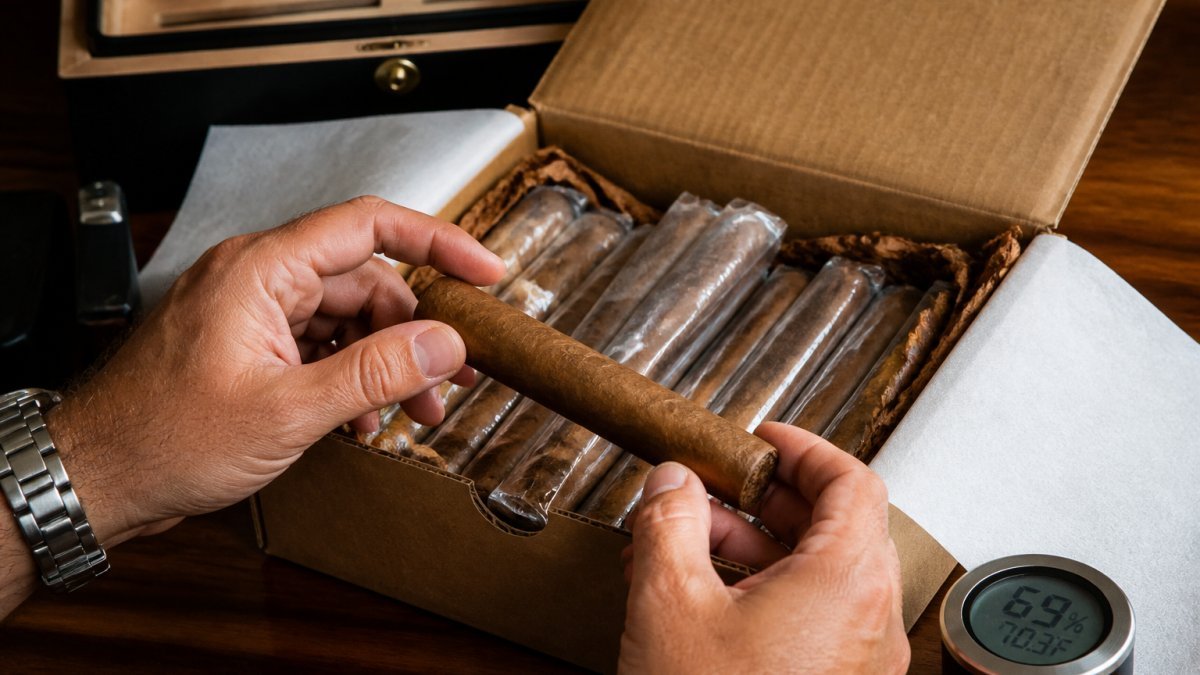
The first hour after delivery is where most guides get vague, “inspect the package” is not a decision. Here is a measurable arrival-quality check, including when to rest cigars sealed and when to open them immediately.
Step 1: Read the parcel before you open it
Look at the outside first: note the transit time, the weather the parcel traveled through, and the box’s condition.
- Crushed or punctured box: handling damage is likely. Open carefully and inspect each cigar for wrapper cracks.
- Condensation on the inside of a bag or box: the parcel went from cold to warm quickly. Do not open the sealed inner bag yet; let it sit at room temperature for a few hours so moisture equalizes.
- Warm box in hot weather: the pack may have worked hard. Expect slightly lower humidity inside.
- Cold box in winter: let the sealed parcel come to room temperature before opening to avoid wrapper cracks from sudden warmth.
Step 2: Decide whether to open or rest sealed
Use this simple tree:
- Is the inner sealed bag intact and the humidity pack still firm or gel-like? If yes, leave the cigars sealed for 24 hours to acclimate to your room temperature. Then open and proceed to Step 3.
- Is the pack dry, burst, or missing, or is there no inner seal? Open immediately. The cigars have no protection and further waiting only dries them out.
- Did the parcel travel through extreme heat or cold? Rest sealed for 12 to 24 hours at room temperature first, regardless of pack condition, to avoid temperature shock.
Do not open a cold parcel in a warm, dry room. The sudden humidity drop can crack wrappers that were fine in transit. Let it equalize first.
Step 3: Run a measurable arrival check
Use three signals together: packaging condition, cigar feel, and a hygrometer reading if available.
- Packaging condition: intact seal and firm pack = low risk; dry or burst pack = high risk.
- Cigar feel: gently press along the length. Firm but slightly springy is good. Brittle and crackly is too dry. Mushy or spongy is too wet.
- Hygrometer reading: if you have a digital hygrometer, place it in the sealed bag with the cigars for 30 to 60 minutes. A reading below 60% RH suggests the cigars dried in transit; above 75% RH suggests excess moisture.
A simple decision rule:
- Good feel, intact packaging, reading 62% to 72% RH: store in your humidor after the 24-hour rest. No recovery needed.
- Brittle feel or reading below 60% RH: begin gradual rehydration (see the rehydration section). Do not smoke yet.
- Mushy feel or reading above 75% RH: dry the cigars gradually by resting them in a lower-humidity environment, and inspect for mold before storing.
- Visible mold, deep wrapper splits, or hollow, dusty interior: the cigar is unsalvageable. Do not smoke it.
Step 4: Store or recover
If the arrival check passes, place the cigars in your humidor at 65% to 70% RH; if it fails, follow the gradual recovery steps below. Slow changes beat fast ones: a cigar moved from 55% to 70% RH in an hour can crack, while the same cigar moved over a week usually recovers.
For more detail on maintaining proper humidity levels after your cigars arrive, explore our humidor guide for better cigar storage. It covers seasoning your humidor and reading a hygrometer correctly.
Checking for Damage and Dryness on Arrival
When you open your shipment, inspect each cigar for visible damage. Look for these specific signs:
Wrapper cracks or splits, These appear as thin lines along the cigar’s length. Minor surface cracks sometimes heal during rehydration; deep cracks through the wrapper are permanent, and the cigar will unravel when smoked.
Soft spots or mushy areas. These indicate overhumidification; mushy spots mean mold may be developing inside.
Discoloration or spots, White or green spots indicate mold. Mold toxins are harmful (the CDC).
For a detailed guide on identifying dried-out cigars, check our signs of dried out cigar tobacco article.
Most minor damage can be fixed: wrapper cracks sometimes seal during rehydration, and brittle cigars can be revived.
How to Rehydrate Dry Cigars After Delivery
If your cigars arrived dry, rehydration is possible. It takes time, but it works.
The two-step rehydration process:
Step 1: Prepare your humidor. Set it to 70% RH.
Step 2: Place the dry cigars in the humidor. Don’t rush: leave them alone for 7-14 days.
Check the humidity pack every few days.
Signs that rehydration is working:
- The wrapper feels slightly springy instead of brittle
- The cigar no longer feels hollow when tapped
- The draw feels smoother when you test it gently
When rehydration is complete:
For complete instructions on storing and rehydrating cigars, review our guide on how to store premium cigars properly.
Rehydration works because cigars are hygroscopic: given time and proper humidity, they absorb moisture back to normal levels.
Ordering Your Next Shipment from Cabrera Cigars
Every order includes:
- Tracking so you know when to expect your order
We source premium, hand-made long filler cigars from brands like Oliva, PDR, and Arturo Fuente. We also offer our own boutique bundles crafted in Nicaragua.
When you order from us, you’re not just buying cigars. You’re buying the confidence that they’ll arrive fresh and ready to smoke.
Add Cabrera Cigars Torpedo to your cart and experience the difference proper shipping makes.
Frequently Asked Questions
What humidity level should cigars maintain during shipping?
Cigars should arrive at 65-70% relative humidity (RH) to preserve quality and burn characteristics. During transit, humidity naturally fluctuates due to temperature changes and air exposure. Proper packaging with humidity packs helps maintain this range. If cigars arrive below 60% RH, they risk becoming dry and developing a harsh burn and cracked wrapper. Above 75% RH, they may develop mold or become overhumidified, affecting flavor.
How can I tell if my cigars arrived too dry?
Inspect the wrapper for visible cracks, splits, or a papery appearance. Gently squeeze a cigar, it should feel slightly spongy, not brittle. Use a hygrometer to check humidity; readings below 60% indicate dryness. Dry cigars may feel light in weight and burn too quickly or unevenly. If detected immediately upon arrival, you can rehydrate them using a humidifier or by placing them in a sealed container with humidity packs for 1-2 weeks.
What should I do immediately when my cigars arrive?
First, inspect the box for external damage and open it carefully. Check each cigar’s wrapper for cracks or discoloration. Use a hygrometer to measure the humidity inside the package. If humidity is above 75%, open the box and let it air out for 30 minutes. If below 60%, leave the humidity pack in place and seal the box. Allow cigars to acclimate to room temperature for 24 hours before moving them to long-term storage.
How long does it take to rehydrate dry cigars?
Rehydration typically takes 1-2 weeks depending on how dry the cigars are and your chosen method. Place dry cigars in a sealed container with 65-70% RH humidity packs or use a desktop humidifier. Check humidity levels every 2-3 days with a hygrometer. Avoid rapid rehydration, which can cause wrapper damage. Once cigars reach the target humidity range and feel slightly springy to the touch, they’re ready to smoke and will have restored flavor and burn quality.
Ensuring cigars arrive humidified requires planning at every step: proper humidity packs, sealed packaging, slow acclimation, and careful inspection on arrival. Most retailers skip these steps to save money. We don’t. At Cabrera Cigars, we’ve built our reputation on cigars that arrive fresh, with the humidity levels you need to enjoy them immediately. Order now and taste the difference.
