

How to Identify Authentic Premium Cigars: A Buyer’s Guide
Last Updated: November 4, 2026
Quick Summary
To identify authentic premium cigars, buy from an authorized retailer, then inspect the band, box and box code. Genuine bands have sharp printing and consistent color, and the box code should match the brand’s published format. Confirm the code through the brand’s official lookup before you smoke.
- Buy from a seller that clearly states where its stock comes from and publishes a physical address.
- Genuine bands show sharp edges, consistent color and clean typography, while blurry lettering signals a fake.
- Check the box code against the brand’s published format, since a code that appears on several boxes proves nothing.
- Type the brand’s known domain yourself for the lookup rather than scanning a QR code printed on the box.
- Keep the box, box code and order confirmation together, because that packet is what a retailer will ask for in a dispute.
Table of Contents
- Why Authenticity Matters When You Buy Premium Cigars
- Start With the Retailer: Authorized Cigar Retailer Verification
- Inspecting the Cigar Band and Printing Quality
- Checking the Box, Packaging and Box Codes
- Signs of a High-Quality Handmade Cigar
- Digital Verification Tools and Tactile Checks
- Booking Your Next Purchase From a Verified Source
- Frequently Asked Questions
Walking into a shop or scrolling a retailer’s page, two authentic premium cigars can look nearly identical. Counterfeits have gotten good enough that a quick glance no longer settles the question. This guide walks through the checks that matter most, from the retailer you choose to the band, box and construction of the cigar itself.
Why Authenticity Matters When You Buy Premium Cigars
A premium cigar is priced for its blend, its construction and its provenance. A counterfeit keeps the look of the brand while missing everything that justifies the price, and a smoker often cannot tell until the cigar is lit. Buying authentic premium cigars protects both your money and the experience you paid for.
Premium cigars earn their reputation through careful tobacco selection, hand-rolling and aging. Our explains why those qualities matter, and our guide to [page] describes what separates genuine quality from cheap imitations. Our [page] explains why those qualities matter, and our guide to [page] describes what separates genuine quality from cheap imitations.
Start With the Retailer: Authorized Cigar Retailer Verification
The single most reliable step is buying from an authorized retailer. A reputable seller sources directly from the brand or from authorized distributors, and that chain of custody is your first line of defense.
Look for a seller that clearly states where its stock comes from, publishes a physical address and customer service contact, and explains its return policy. Authorized cigar retailer verification is worth doing before you look at a single cigar.
Inspecting the Cigar Band and Printing Quality
Once the cigar is in hand, start with the band. Genuine bands are printed with sharp edges, consistent color and clean typography. Blurry lettering, uneven gold foil, off-colors and misspelled words are typical of fakes.
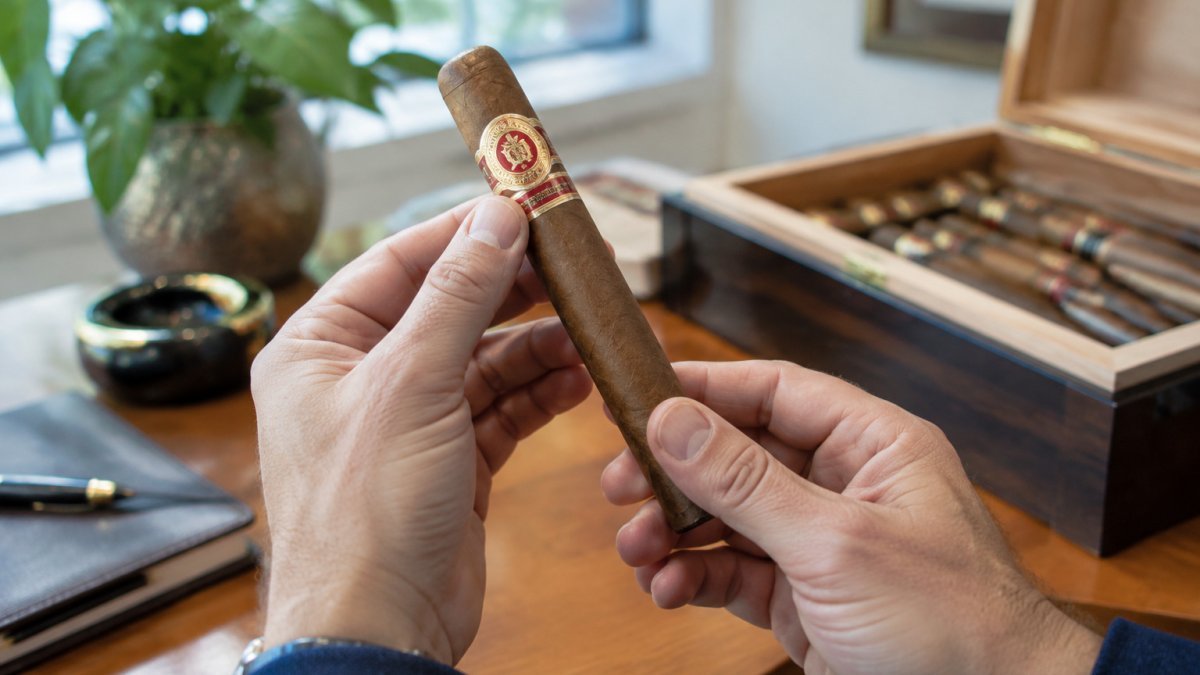
Compare the band against a reference photo from the manufacturer’s site. Pay attention to the font, the spacing of the text and the way the band sits on the wrapper. A band that looks slightly too glossy, too pale or loosely applied deserves a second look.
Checking the Box, Packaging and Box Codes
Premium cigars usually arrive in a box that carries its own quality cues, and the box is often where counterfeiters slip first. Check the wood grain, the joinery and the finish, then look at the box code, which is typically stamped or printed on the inside of the lid or on the bottom of the box. Box codes help confirm the production period and can be compared against the brand’s published references.
A box code is not a single number. On many premium brands it is a short string that encodes the factory, the month and year of production, and sometimes the packaging line. The exact format varies by brand, so the reliable method is to pull the brand’s own reference page or contact its customer service and compare the code character by character. A code that does not match the brand’s published format, or that decodes to a date after the cigars could plausibly have shipped, is a warning sign.
Watch out: counterfeiters often copy a real box code from a genuine box onto many fakes, so a code that looks valid on one box proves nothing if the same code appears on multiple boxes you are comparing.
Beyond the code, inspect the physical packaging. Look for a government-issued tax stamp or seal where required, and check that it is intact and correctly aligned.
Note any mismatch between the box and the cigars inside, such as a box claiming one vitola while the cigars differ in length or ring gauge, or a box labeled for one wrapper color holding cigars of another. Inconsistent packaging, cheap glue, fuzzy printing on the box label, or a lid that does not seat flush all point toward a closer inspection. Keep the box, the code and your order confirmation together; if a dispute arises, that combination is the evidence a retailer or brand will ask for.
Before you smoke, compare the box and its code against the reference points below.
| Check | What to look for | Red flag |
|---|---|---|
| Box code | Matches brand’s published format | Does not match the format |
| Box code date | Production date is plausible | Date after the cigars could have shipped |
| Box code repeat | Unique to one box | Same code appears on several boxes |
| Tax stamp | Intact and correctly aligned | Missing, torn or misaligned |
| Vitola match | Cigar size matches the box label | Length or ring gauge differs from label |
| Box finish | Clean joinery and finish | Cheap glue or loose lid fit |
Signs of a High-Quality Handmade Cigar
Handmade cigars reward a close examination. The details below are where skilled rollers separate their work from machine-made or poorly made product.
Wrapper consistency, construction and symmetry
A well-made cigar has a wrapper that is smooth, even in color and free of large veins or tears. The cigar should feel firm but not rock-hard, with no soft spots along its length. Hold it up and check that the body is straight and the taper is even.
Draw, burn and ash structure
These qualities are best judged by smoking, but a careful buyer can read clues before lighting. Gently squeeze the cigar to check for consistent filling and roll a small amount between your fingers to feel for moisture. Once lit, a quality cigar tends to burn evenly and hold a firm ash. Uneven burning, a flaky ash or a very tight or very loose draw can suggest poor construction.
Digital Verification Tools and Tactile Checks
This section covers verification you can perform yourself, including a documented lookup and a set of sensory tests.
Digital verification: serial and box-code lookups
Many premium brands publish an online lookup for box codes or serial numbers, and some provide a QR code or scratch-off panel on the box that resolves to a verification page. The process is consistent: locate the code on the box or band, go to the brand’s official site (not a link printed on the box alone), enter the code, and confirm that the returned product, vitola and production window match what you are holding. A code that returns no record, returns a different product, or has already been claimed is a red flag.
Watch out: a QR code printed on a counterfeit box can point to a convincing copy of the brand’s site, so type the brand’s known domain yourself rather than scanning blindly.
Keep your order confirmation, the box code and any authentication documentation together. If a dispute arises, that packet is what a retailer or brand will ask for, and it is far more persuasive than a photo of the cigar alone.
Tactile checks: firmness, weight and fill
A well-made handmade cigar should feel firm but not rock-hard, with no soft spots along its length. Roll it gently between your fingers: you should feel consistent resistance from head to foot. A cigar that feels spongy in one spot and hard in another, or noticeably lighter than another cigar of the same vitola, often has uneven or short filler. Counterfeits frequently feel lighter, spongier or unevenly packed because the tobacco inside is not the long filler the band promises.
Olfactory checks: aroma before lighting
Authentic aged tobacco has a natural, earthy or cedar-like aroma that is hard to fake convincingly. Run the cigar under your nose along its length before lighting. A sharp chemical smell, an ammonia bite, or a flat, dusty smell is worth noting. A common pattern is that counterfeiters use lower-grade leaf that has not been properly fermented or aged, and the aroma gives it away before the first puff.
Draw and burn as confirmation
These qualities are best judged by smoking, but a careful buyer can read clues before lighting. Gently squeeze the cigar to check for consistent filling, and test the draw on an unlit cigar by taking a cold pull if the retailer allows it. Once lit, a quality cigar tends to burn evenly and hold a firm ash. Uneven burning, a flaky ash, or a very tight or very loose draw can suggest poor construction and is consistent with counterfeit or lower-grade product.
Booking Your Next Purchase From a Verified Source
Authenticity starts with where you buy. [page] will help you find a verified seller, and [page] lays out the factors to weigh before you commit. Once you have chosen a source, [page] shows what to look for in a well-curated selection.
Browse the curated selection of premium, hand-made long filler cigars and boutique bundles when you are ready to buy.
Frequently Asked Questions
What are considered premium cigars?
Premium cigars are generally hand-rolled, made with long filler tobacco and a whole-leaf binder and wrapper, and sold in the higher price tiers of the market. Hand-rolling, consistent construction and careful tobacco selection separate them from machine-made products. Pricing varies widely by brand, size and quantity, so check Cabrera Cigars’s website for current prices or a quote rather than relying on a general figure. Looking at how a cigar is rolled and finished will tell you more than the label alone.
How to tell if a cigar is high quality?
Start with construction. A high-quality cigar has an even, firm roll with no soft spots, a wrapper that is smooth and consistent in color, and a cap that is cleanly applied. Draw a test puff through the cigar before lighting it to check airflow. Once lit, the burn should be even and the ash should hold together for a noticeable length. Signs of a high-quality handmade cigar are easiest to judge when you compare two cigars side by side from the same source.
How can you verify the authenticity of a cigar box?
Check the box for crisp printing, sharp logos, consistent font and accurate colors. Look for the box code and any serial or lot numbers, then confirm they match what the retailer lists for that shipment. Inspect the wood or cardboard finish for clean joints and even lacquer. Counterfeit boxes often show blurry type, off-colored graphics or mismatched codes. If anything looks off, buy from a source you can contact and ask for verification before you open the packaging.
Why is purchasing from authorized retailers the best way to ensure authenticity?
Authorized retailers buy directly from the manufacturer or its approved distributors, so the cigars they sell pass through a traceable chain. Ask the retailer whether it is an authorized dealer for the brands it carries and whether it can document where its inventory came from. Retailers that stand behind their products will answer these questions clearly. You can reach Cabrera Cigars through its website with questions before you order.
